

How to increase profit without increasing sales? Managing the weighted average gross margin and the product mix
Most managers concentrate on growing sales. That is natural, because revenue is easy to measure and is often the main business goal. The problem is that higher sales do not always mean higher profit. A far more important question is: what are we selling, and what gross margin do the products we sell generate?
In practice, a company’s profit can be increased without winning new customers, without expanding the sales team and without increasing the value of sales. It is enough to manage the product mix and the weighted average gross margin consciously.
The same sales, a higher margin
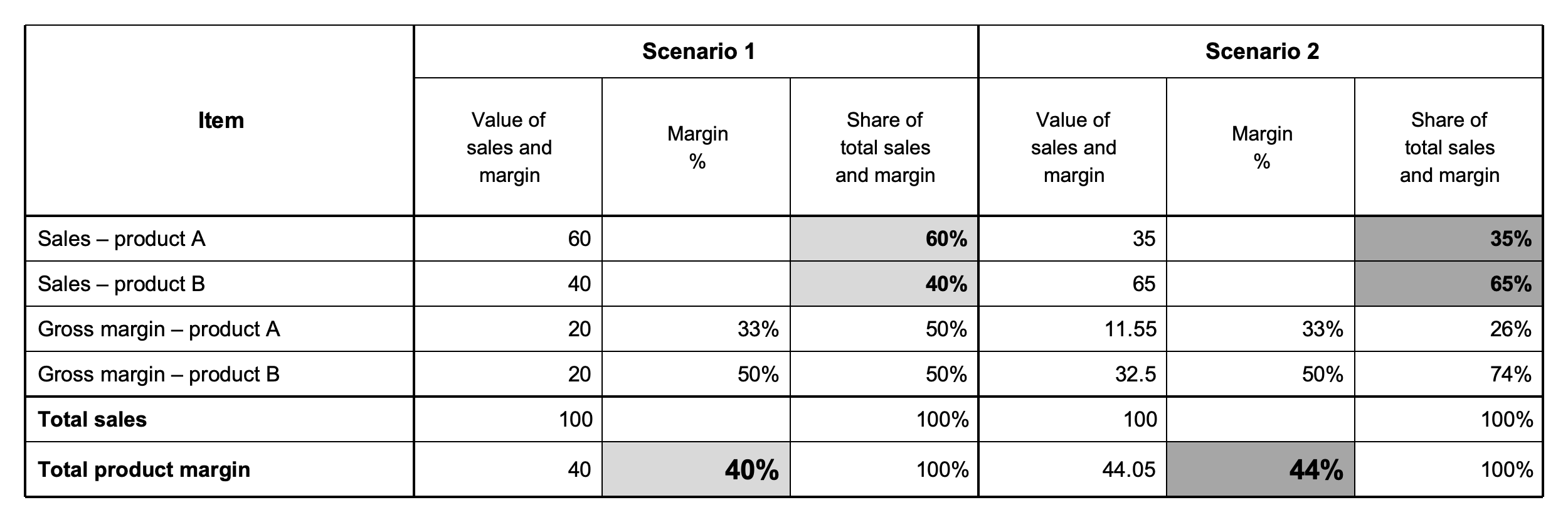
Let us look at a simple example involving two products. In the first scenario, product A accounts for 60% of sales and generates a gross margin of 33%, while product B makes up 40% of sales at a margin of 50%. The overall product margin is 40%.
In the second scenario, the products’ margins stay practically the same, but the sales structure changes. The higher-margin product takes a larger share of sales. As a result, the total product margin rises from 40% to more than 44%, even though total sales remain at the same level.
This is the weighted average gross margin at work.
We did not change prices. We did not increase the number of customers. We did not increase sales.
We changed only the share of each product in total revenue.
The result? Higher profit.
Why do managers often fail to see this?
In many companies, sales reports show turnover above all. The board sees revenue growing, the sales staff are meeting their sales targets, and the owner is pleased with the growing invoices.
Yet real business value is created at the level of margin.
Two salespeople may generate identical sales worth PLN 1 million. If the first sells mainly products with a 20% margin and the second sells products with a 40% margin, their effect on the company’s result will be radically different.
That is why modern sales management should not concentrate solely on revenue. It should also cover:
gross margin,
weighted average gross margin,
customer profitability,
the profitability of product categories,
the effect of discounts on the result,
the sales structure (product mix).
The problem begins at 2,000 products
With two products, everything seems simple. A manager can analyse the results in Excel unaided and draw conclusions quickly.
The situation changes radically when a company has 200, 500 or 2,000 product lines.
Questions then arise:
Which products generate the highest margin?
Which products account for the largest share of profit?
How does the weighted average gross margin change once discounts are given?
Which products should the sales staff be promoting?
Which groups of customers buy the most profitable range?
How will a change in prices affect the profitability of the whole product portfolio?
At that scale, analysis in Excel becomes difficult, time-consuming and prone to error.
Why is Excel not enough?
Excel remains an excellent tool for analysis, simulation and reporting. But managing margin in an organisation with hundreds or thousands of products requires a systematic approach.
The best companies use Business Intelligence solutions and ERP systems, which make it possible to monitor:
gross margin in real time,
customer profitability,
product profitability,
the effects of discount policy,
changes in the product mix,
the effect of commercial decisions on the financial result.
As a result, the manager is not managing sales alone. They are managing profit.
The most important lesson for a business owner
Sales growth is not an end in itself.
The goal is to increase the value of the company, and that comes from adequate profitability. That is why managing gross margin effectively requires not only control of costs and prices but also conscious shaping of the product mix.
Often the biggest improvement in the financial result does not come from winning new customers. It comes from steering existing sales towards higher-margin products.
In other words:
you do not always have to sell more. Often you have to sell smarter.
If you want to understand financial indicators, gross margin, cash flow, profitability and the effect of business decisions on a company’s results better, I invite you to join the programme Kowale Biznesu Tłumaczą Finanse (“The Business Smiths Explain Finance”). It is a practical course for business owners, managers and leaders who want to use finance as a tool for making better business decisions, and not merely for reporting on the past.