

Trainer, coach, mentor or consultant – who to choose?
Companies and their managers use outside help when they want to improve results and speed up their own development, but also to cope with the day-to-day challenges of running a company and managing human capital. Managers rarely use outside help, for the following reasons:
They do not see, or do not even want to see, the problems in their own company.
They believe it will be cheaper to solve the problems with internal resources.
Managers’ egos do not allow for the possibility that someone from outside might notice something they cannot see.
Those in charge think their problem is too complicated for anyone from outside their company or industry to be able to help.
Companies believe that the quality of outside advisory help is too low in terms of the value it adds, compared with the price paid for it.
Why does outside help add value to a company?
Even the best company has problems that get in the way of its smooth development. Poorly organised companies should diagnose the causes of their weakness, which lie mainly within themselves and not in external factors.
An outside view of a company is always valuable feedback, provided it is turned into corrective action.
Managers’ excessive egos are one of the main causes of company failures.
An experienced helper is able to “learn” a company and the rules governing its industry quickly, and to initiate change.
The financial benefits of outside support can significantly exceed the cost of an experienced consultant, adviser or mentor, and they can be measured precisely.
There are many forms of support that companies can use, but the people who run them often do not know what each form of help offers. This post will help you explore the subject.
Forms of outside support
A coach, in a simplified definition, is a person who asks the right questions, which help the client find the right answers. A coach helps the client (the coachee) to examine their own resources, remove the barriers to using them, set goals and strengthen their determination to achieve them. A coach does not have to understand the client’s business, but helps the coachee reach the right conclusions for themselves. Coaching may concern work, personal life or career, and often all of these at once. If you have complex problems in your company, this method of support is helpful, but it takes a long time and is often not enough to bring about radical change. When choosing a coach, it is worth knowing that the profession is certified by coaching federations, which adds to the credibility of the method, but that you may also come across self-taught “coaches” who do not have the proper training to provide this form of support.
A trainer usually trains a group of people in particular skills and competences. Training varies in how effectively the knowledge gained is put into practice in the company. This depends on the quality of the trainer (their technique, and the quality of the content and tools they use), on the selection of the group being trained, and on the commissioning companies, which are ready to varying degrees to put the changes they have learned into practice. It can be an effective way of raising particular skills among those trained, but it can also be money partly wasted. It is not a sufficient way of carrying out radical change in a company, but it can be a good tool for preparing employees for part of it.
A mentor helps the client (the mentee), most often using coaching tools, but their main advantage over a coach is the experience they can share. A mentor does not impose solutions but shows a variety of options that the client can use, or from which the client can work out their own unique solutions. Business mentoring can take the form of one-to-one meetings, of sessions for a team within one company, or of group sessions for people from different companies working in a given field. This method seems to be more effective than coaching for carrying out comprehensive change in a company, especially as team mentoring, in which all the decision-makers work together. The condition for success is comprehensive business knowledge on the part of the mentor, who must be able to command the team in terms of both substance and communication. Mentors of that calibre are, unfortunately, rare on the Polish market. The profession of mentor is certified by mentoring federations, but when choosing one, their varied experience and psychological awareness matter far more.
A business adviser (consultant) solves the problems of the client’s company that the client has commissioned them to solve. Advisers work individually or as a team, within consulting firms. Consultants analyse the situation and the data and propose solutions. Sometimes their help ends with a final report on their work; sometimes they work with the client on implementing the changes. The largest consulting firms are usually too expensive for most SMEs, while freelance advisers are more affordable, although their professional standard varies. I describe how to choose an adviser in another post on this website.
An interim manager is a person who comes into a company for a period and puts it in order as chief executive or head of a department. Their aim should be not only to deliver the intended result but also to bring on a successor who will take over the management after they leave.
There are also other forms of support for companies that are worth considering:
Outsourcing of functions means handing certain functions over to external companies, which is common among SMEs for accounting, HR and payroll, and marketing. It is a flexible solution that often lowers costs, but it can be risky, because external companies sometimes do the work superficially, do not always have a feel for the client’s particular circumstances and deliver services of too low a standard. As companies grow, many of them move to in-house solutions, that is, they build the outsourced capabilities internally.
Books, online courses, webinars and podcasts are a good source of business knowledge, but they require great determination in implementing the changes you have heard about – in other words, self-reflection on what is going on in the company and what to do to make it better. For many people, simply reading a book or listening to a webinar is not enough to spur them into significant change, and they need outside support to jolt them out of their daily operational routine.
A psychologist or therapist helps when an entrepreneur is struggling with psychological problems, often directly connected with work. These may take the form of burnout, depression, psychosomatic problems, mental illness, or problems in relationships at work and in personal life.
Which support should you choose?
The choice of method of outside support depends on the following.
Who it concerns:
An individual – coaching, one-to-one mentoring
A team – team mentoring
A company – team mentoring, one-to-one mentoring of the owner, consulting
What it covers:
A specific skill or competence – training, coaching, mentoring
A complex set of skills and competences – team mentoring, one-to-one mentoring of the owner, consulting
How urgent the need for change is:
The need has to be met as quickly as possible – depending on how readily available the given source of help is
The need can be met later – coaching
What the budget for outside help is:
Low – occasional, one-off support by any method
Medium – a local consulting or training firm, a local mentor
High – a large consulting firm, a celebrity mentor
How ready the person or company is for change:
Low – coaching, in which the coachee reaches the right conclusions for themselves
Medium – all methods
High – the cost and type of support are secondary, as long as it works
What quality of support is expected for the cost:
Low value for money – the risk of hiring support that is incompetent but cheap
High value for money – hiring high-quality support that will deliver the expected result
The client’s level of knowledge:
Low – basic forms and scopes of help first
Medium – more advanced forms and scopes of help
High – executive mentoring and one-to-one coaching
On the basis of the breakdown above, it is fair to say that choosing a single method of supporting a client and closing oneself off from other approaches seriously limits their effectiveness. It is very tempting to use an approach that combines several methods without breaking the rules for applying each of them.
Hire a mentor, consultant, trainer and coach in one person!
There is no shortage of trainers, coaches, mentors or consultants on the market, but – as in other professions – few of them offer a really high standard of service and a holistic view of the client’s needs. It is very hard to find someone who can skilfully combine coaching techniques with rich experience in mentoring, and apply them to solving a company’s real problems in a consulting approach.
Choosing a good coach, trainer, business mentor and consultant in one person is a complicated process. Many coaches and mentors have an education or training in psychology without sufficient experience in business. Few directors will want to listen to questions asked by, say, a 27-year-old coach, even one who holds a valid certificate from one of the renowned coaching schools. Many experienced managers and consultants do not know or use coaching tools, or do not have sufficiently developed soft skills. The largest consulting firms are too expensive for most small and medium-sized companies in Poland.
In this context, I would immodestly like to recommend my own services, because in helping more than 230 companies in more than 50 industries I have always combined different methods of support, depending on the client’s specific needs, as the graphic below shows.
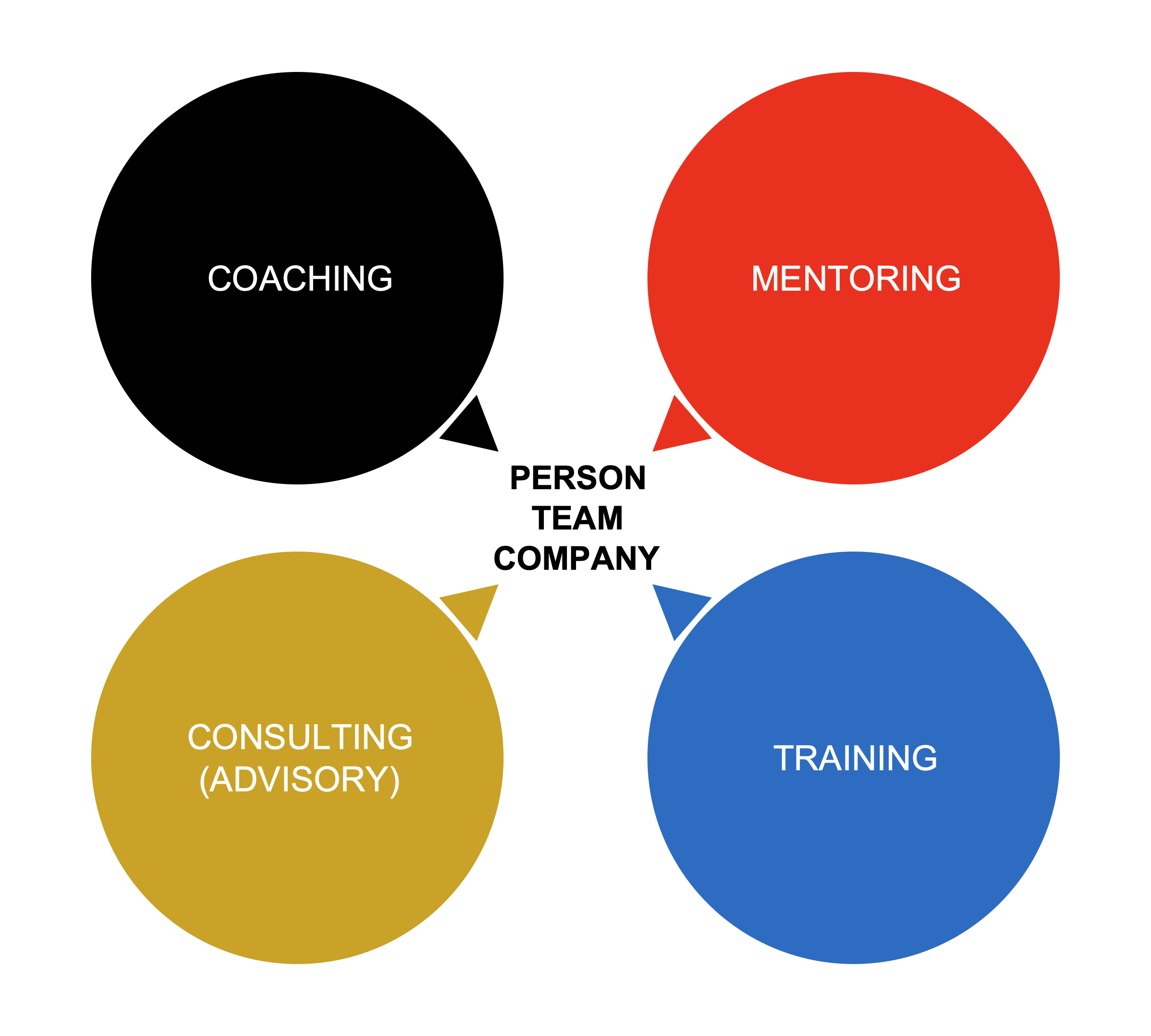
This means that I can use team mentoring in a meeting with the client’s management team and, in the course of it, carry out a coaching intervention with one of the participants, then talk to the company’s chief executive in a one-to-one mentoring session and agree with them the tasks that I will carry out as consulting.
I have coaching skills (a course at the ICC school), I apply the EMCC code of ethics in my mentoring, I have 35 years of experience in business, including at Nike and Telepizza, I have trained hundreds of managers, I take part in many business education projects and entrepreneurship clubs, I am a recognised expert on leadership and management, and I have a long list of recommendations from satisfied clients. I work alone, which is why I get to the root of problems faster than the competition – and, when I am paid by the hour, far more cheaply.