
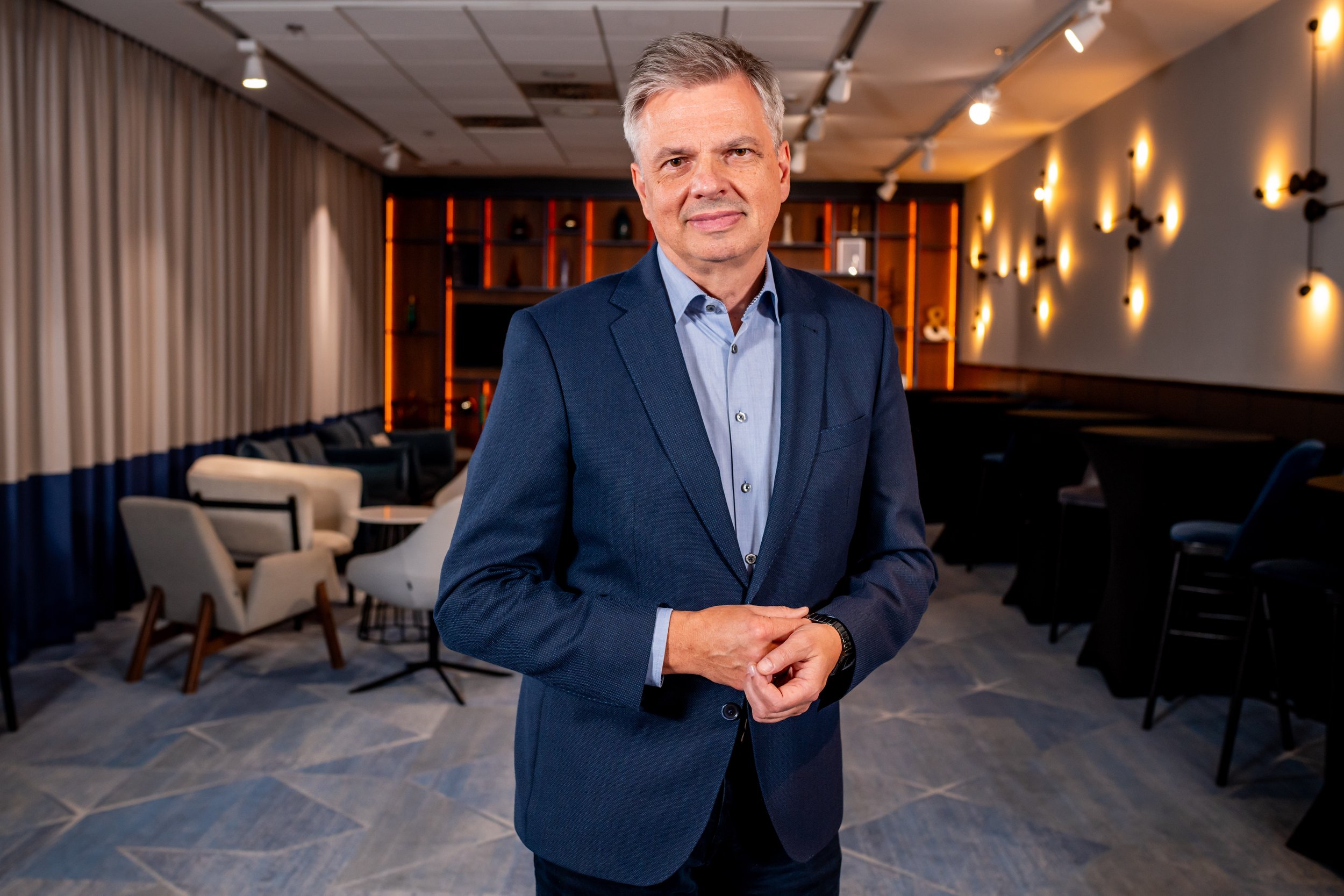
Diagnosing your company before change and AI. Is your organisation ready for healthy scaling?
Many business owners and managers know that something is not working as it should. Sales are growing more slowly than they used to. Costs are slipping out of control. Employees are less engaged. The projects being implemented are not delivering the expected results. So a natural temptation arises: let’s act immediately.
The problem is that acting without a proper diagnosis is often like giving medicine without identifying the illness.
In business, how well a fix works depends on the quality of the diagnosis. The more complex the organisation, the more dangerous it becomes to look at only one selected part of the company. That is exactly why the first stage of any serious change should be a holistic look at the business as a whole. This approach is the foundation of the diagnostic method I have been using for years in my work with business owners and boards.
A company is a system of communicating vessels
One of the most common mistakes is the belief that the problem lies exactly where its effects are visible. If sales fall, the owner invests in marketing. If the margin shrinks, they start cutting costs. If they are unhappy with their employees, they organise training.
Yet the source of the problem is often somewhere else entirely.
Low sales may be the result of the wrong strategy, a weak offering or problems with customer service. Low profitability may be the consequence of faulty processes, poor planning or the wrong pricing policy. Staff turnover may have its cause in the organisational culture, the quality of leadership or an unfair incentive system.
A company is a system of interconnected elements: strategy, products and services, organisation, processes, people, knowledge, motivation and financial results. A weakness in just one of them can hold back the development of the whole business. This holistic view of the organisation is the basis of an effective diagnosis.
Why must AI readiness be part of the diagnosis?
Only a few years ago it was possible to diagnose a company without taking artificial intelligence into account. Today that would be a serious mistake. Not because every company must implement AI immediately, but because artificial intelligence is becoming another layer of how an organisation functions. AI does not fix chaos. AI speeds it up.
If the sales process is badly designed, artificial intelligence can only generate errors faster. If the data are incomplete, automation will make wrong decisions faster than a human would. If employees do not understand the purpose of the changes, even the best tools will go unused.
That is why a modern diagnosis has to answer these questions:
Does the organisation have well-ordered processes?
Is there a single source of truth for data?
Are the ERP and CRM systems and other applications connected to one another?
Do managers understand the potential of AI?
Does the organisational culture favour change?
Which processes can be automated with the greatest return on investment?
Without answers to these questions, AI implementations often become costly experiments instead of a source of competitive advantage.
How do you diagnose people, knowledge and motivation?
The hardest area of any diagnosis is people. Systems can be seen. Processes can be described.
Financial results can be measured. It is much harder to assess a team’s level of knowledge, its motivation or its readiness for change. The key is to examine several areas:
technical and managerial skills,
the level of cooperation between departments,
the quality of leadership,
organisational culture,
trust in the board,
willingness to learn,
openness to AI and automation.
In practice, an anonymous employee survey is an extremely effective tool. Why?
Because a warehouse worker, a salesperson, a specialist, a manager and a board member often live in completely different organisational realities.
Anonymity reduces the fear of consequences and makes it possible to obtain information that cannot be drawn out in official meetings. In many cases it is the anonymous survey that reveals the real barriers to the company’s growth, and the differences between what management declares and what employees experience every day.
Is the company ready for healthy scaling?
Many entrepreneurs confuse growth with scaling. Growth usually means higher sales, more customers and more employees. Scaling means increasing the value of the company while costs grow relatively more slowly. The key questions are:
Does the company run well without the owner’s constant presence?
Are the processes repeatable?
Are responsibilities clearly defined?
Are results measured?
Does knowledge reside in the organisation, and not just in the heads of individuals?
Does the company have the data it needs to make decisions?
If the answers are “no”, the organisation is usually not ready for healthy scaling. The foundations have to be put in order first.
Why do companies avoid a diagnosis?
There are usually three reasons.
1. Past success gives a false sense of security
Owners often try to solve new problems with methods that worked five or ten years ago. The market, however, changes. Customers, technology, business models and competitors all change. What was once an advantage may today be a limitation.
2. Fear of the truth
A diagnosis sometimes shows uncomfortable facts. It may reveal strategic mistakes, poor staffing decisions or ineffective processes. For many people it is easier to go on believing that “we just need to work harder” than to accept the need to change the way they operate.
3. Intuition takes the place of data
Intuition is valuable. The problem begins when it becomes the only basis for decisions. In a small business, the owner’s intuition often works very well. In a larger organisation, it starts to lose out to objective data. Numbers have no emotions. They have no ego. They are not trying to protect anyone. They show reality as it is. That is why the analysis of financial results, cash flow, margins, productivity, sales and process efficiency is one of the most important elements of a professional diagnosis.
Why is outside support needed?
Every organisation has its own cognitive filters. Owners, boards and managers look at reality through their experience, their emotions and their earlier successes. That is normal. It is exactly why someone from outside is often needed. An independent diagnostician takes no part in the company’s conflicts, does not defend earlier decisions and is not entangled in organisational relationships. They can look at the business without baggage and call a spade a spade. Very often that look alone is enough to reveal problems that are invisible from the inside.
Why are few consultants able to carry out such a diagnosis?
A true company diagnosis is not a matter of analysing one department. It requires an understanding, all at once, of:
finance,
sales,
marketing,
strategy,
operational processes,
people management,
leadership,
technology,
IT systems,
AI implementation.
Added to this is the ability to work with business owners, boards and employees at different levels.
It is harder still to carry out such a diagnosis quickly without losing quality. This combination of broad business experience, analytical skills and the ability to synthesise a large amount of information in a short time is the reason why few consultants are able to conduct such a process effectively.
Why can you entrust me with diagnosing your company?
For more than three decades I have had the opportunity to observe business from different perspectives: corporate, entrepreneurial and consulting.
I was CEO of Nike Poland for 13 years and CEO of Telepizza Poland for 7 years, and I have since advised more than 230 companies in dozens of industries. In practice, that means thousands of hours spent analysing strategy, finance, processes, sales, organisational structures and human behaviour.
I combine management experience with finance, leadership, organisational transformation and AI implementation. As a result, the diagnosis does not stop at pointing out problems. Its aim is to find the shortest route to increasing value for the customer, the employees, the owners and the company itself.
In a world of constant change, a diagnosis is not a cost. It is an investment.
Because before a company starts to run faster, it should be sure it is running in the right direction.
The price of a diagnosis of your company: PLN 6,000–10,000 net + VAT
The price depends on the size of the company and the complexity of its problems. It is a unique service on the consulting market, combining speed with quality.